
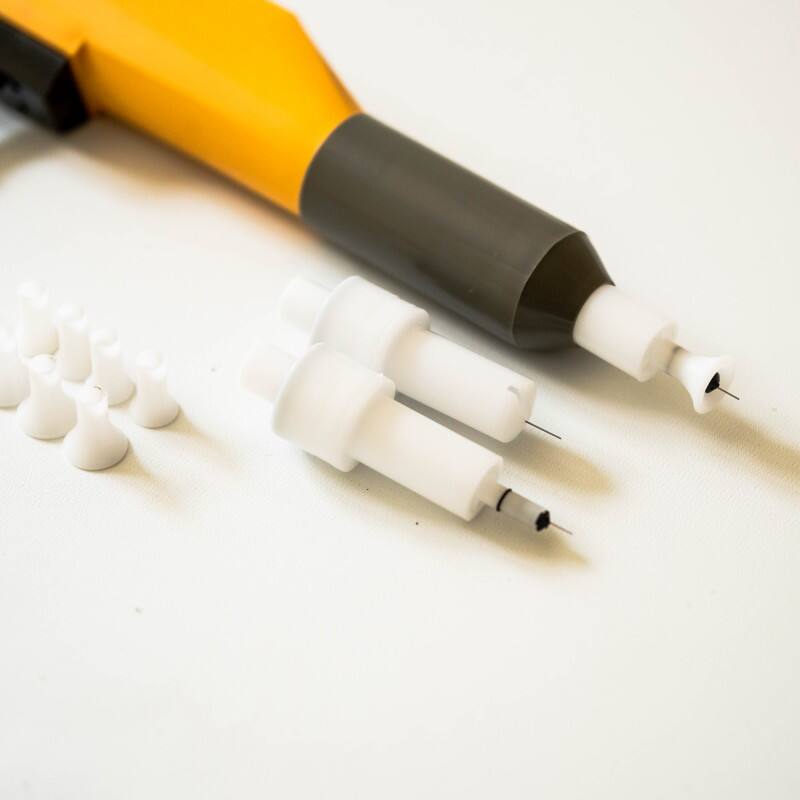
How Nozzle Geometry Shapes Spray Pattern Formation in Powder Coating Spray Guns
Swirl Chamber Design and Inlet Orientation: Axial vs. Tangential Flow Effects on Pattern Symmetry
Swirl chamber configuration fundamentally governs airflow dynamics—and thus spray symmetry—in powder coating spray guns. Axial inlets generate concentric, laminar airflow that produces highly symmetrical, circular patterns ideal for uniform coverage on flat or simple geometries. Tangential inlets, by contrast, induce controlled vortex flow, yielding elliptical patterns with enhanced edge definition—critical for coating recessed features while minimizing overspray. Studies from the American Coatings Association (ACA) show tangential designs improve transfer efficiency by 15–20% on complex parts by concentrating particle distribution toward target zones. Yet axial configurations offer superior pattern stability across pressure fluctuations, reducing rework by up to 30% in high-volume flat-panel production. The selection hinges on part geometry: tangential for directional control on intricate contours; axial for consistency on symmetrical substrates.
Orifice Geometry Essentials: Cone Angle, Edge Sharpness, and Orifice Shape Impact on Stability and Uniformity
Three geometric parameters define orifice performance: cone angle, edge radius, and exit shape. Narrow cone angles (15–25°) yield tightly focused streams suited for deep recesses but risk uneven buildup on broad surfaces. Wider angles (60–80°) broaden coverage at the expense of penetration depth. Edge sharpness is especially critical—exits with radii under 0.1 mm suppress turbulent eddies, cutting pattern deviation by 40% compared to chamfered orifices. While circular orifices ensure predictable flow rates, elliptical variants enhance wrap-around on tubular parts. Hexagonal orifices, validated in recent ASTM D7989-compliant testing, improve edge acuity by 22% over circular equivalents—delivering sharper pattern boundaries without compromising flow stability. For high-tolerance applications, precision-machined orifices held to ≤5 μm dimensional tolerance maintain film thickness uniformity within ±2 μm.
Core Spray Pattern Types and Their Functional Trade-offs for Powder Coating Spray Guns
Flat Fan vs. Hollow Cone: Transfer Efficiency, Wrap-Around Capability, and Substrate Geometry Fit
Flat fan patterns maximize transfer efficiency—typically 80–90% on planar surfaces—by projecting powder in a focused, elliptical curtain optimized for flat panels and simple brackets. However, their limited wrap-around capability reduces efficiency by 15–20% on contoured or multi-axis parts. Hollow cone nozzles overcome this via toroidal vortex flow, enabling full 270° circumferential coverage of cylindrical components like pipes and enclosures in a single pass. This comes with a trade-off: hollow cones incur a 10–15% reduction in material adherence on flat surfaces due to inherent air turbulence. Matching pattern to substrate is non-negotiable—flat fans dominate where material utilization is paramount (e.g., architectural sheet metal), while hollow cones are indispensable for uniform coating of tubular geometries.
Full Cone and Solid Stream: Precision Targeting Use Cases for High-Tolerance or Low-Profile Features
Full cone patterns emit a homogeneous, radially symmetric cloud with tight particle distribution (±5% thickness variation), making them essential for coating intricate, multi-faceted components—such as fasteners, electrical enclosures, or automotive brackets—where consistent film build is critical. Solid stream nozzles concentrate powder into a narrow, high-velocity jet for sub-millimeter targeting—ideal for recessed grooves, heat sink fins, or weld seams where overspray must be eliminated. Though full cones hold ±0.2 mil thickness tolerances across complex surfaces, solid streams sacrifice throughput for accuracy. In practice, full cones support high-fidelity base layers in automotive assemblies, while solid streams handle precision touch-ups and aerospace fixture features requiring micron-level control.
Matching Powder Coating Spray Gun Patterns to Part Complexity: A Progressive Application Framework
Stage 1: 2D Profiles (e.g., Flat Panels, Brackets) — Optimizing Coverage Uniformity
For planar substrates, flat fan patterns deliver optimal first-pass coverage—achieving up to 95% uniformity on flat panels when applied at 6–8 inches with consistent traverse speed and gun perpendicularity. Deviations beyond ±15° induce edge buildup and thickness gradients. Electrostatic assist significantly mitigates Faraday cage effects at bracket edges, improving deposition efficiency by 40% versus non-assisted spraying.
Stage 2: Axisymmetric & Tubular Geometries (e.g., HVAC Ducts, Pipes) — Leveraging Wrap-Around Dynamics
Hollow cone patterns excel here, using centrifugal force and vortex-induced radial dispersion to achieve true 360° encapsulation—particularly vital for pipes 4 inches in diameter. Performance depends on matching cone angle to curvature: 30° nozzles suit small-diameter tubing, while 70° variants prevent sagging on large HVAC ducts. This approach cuts overspray by 25% compared to sequential flat fan passes and eliminates manual repositioning.
Stage 3: Complex 3D Assemblies (e.g., Engine Cradles, Chassis Frames) — Combining Pattern Types and Gun Positioning Strategy
Multi-geometry parts require adaptive pattern sequencing and intelligent robotic path planning. Begin with full cone nozzles for recessed cavities (0.5–1.5 inch depth) to ensure corner penetration, then transition to flat fans for broad surface areas. Maintain gun angles of ~45° toward internal corners to reduce shadowing. On chassis frames, integrate rotary atomizers for uniform base layers and precision round sprays for weld seams—cutting touch-up labor by 30%. Real-time voltage modulation further compensates for variable ground paths across conductive assemblies, preserving charge retention and film integrity.
FAQ
What is the impact of nozzle geometry on spray pattern formation?
Nozzle geometry, including swirl chamber design and orifice shape, directly affects the spray pattern formation in powder coating spray guns by controlling airflow dynamics and particle distribution.
How do axial and tangential swirl chamber designs differ?
Axial designs generate concentric airflow for symmetrical patterns, while tangential designs create vortex flow for elliptical patterns, enhancing edge definition and control on complex geometries.
What spray pattern types are best for different substrate geometries?
Flat fan patterns are optimal for flat surfaces, while hollow cone patterns are beneficial for tubular geometries. Full cones and solid streams are best for high-tolerance features and precision targeting.
How does orifice geometry influence spray stability?
Orifice geometry involves cone angle, edge sharpness, and shape, influencing flow stability and uniformity. Sharp edges reduce turbulence, while different shapes cater to specific geometrical features.
Table of Contents
- How Nozzle Geometry Shapes Spray Pattern Formation in Powder Coating Spray Guns
- Core Spray Pattern Types and Their Functional Trade-offs for Powder Coating Spray Guns
-
Matching Powder Coating Spray Gun Patterns to Part Complexity: A Progressive Application Framework
- Stage 1: 2D Profiles (e.g., Flat Panels, Brackets) — Optimizing Coverage Uniformity
- Stage 2: Axisymmetric & Tubular Geometries (e.g., HVAC Ducts, Pipes) — Leveraging Wrap-Around Dynamics
- Stage 3: Complex 3D Assemblies (e.g., Engine Cradles, Chassis Frames) — Combining Pattern Types and Gun Positioning Strategy
- FAQ