
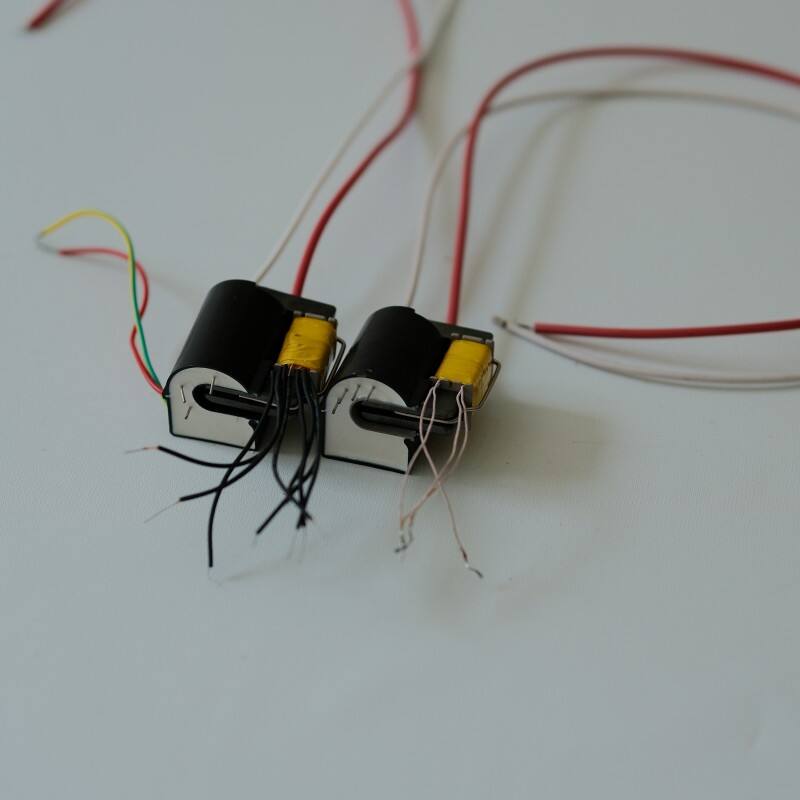
Operating Principles: Energy Storage vs. Energy Transfer
How Flyback Transformers Store and Release Energy (Discontinuous Conduction Mode)
Flyback transformers function as coupled inductors, storing energy in their magnetic core during the switch-on phase. When the primary-side MOSFET activates, current flows through the primary winding, building magnetic flux while the secondary diode remains reverse-biased—preventing energy transfer to the output. During the switch-off interval, the collapsing magnetic field induces voltage in the secondary winding, releasing stored energy through the now-forward-biased diode to the load. Operating in discontinuous conduction mode (DCM) ensures complete core demagnetization between cycles, preventing saturation. This storage-release mechanism eliminates the need for a separate output inductor but results in higher peak currents and inherent output voltage ripple—typically 1–2% of nominal output—requiring robust filtering. Leakage inductance must be carefully managed to suppress electromagnetic interference (EMI), especially since flyback-based power supplies under 100 W exhibit up to 15% higher EMI emissions than forward alternatives.
How Forward Transformers Couple Energy Only (Continuous Conduction Mode)
Forward transformers act as pure magnetic couplers, transferring energy directly from input to output without intermediate storage. During the switch-on period, energy flows simultaneously through primary and secondary windings via transformer action, powering the load while charging an output inductor. The secondary diode conducts immediately, enabling continuous power delivery. In continuous conduction mode (CCM), current continues flowing through the output inductor during switch-off intervals—minimizing current ripple to under 0.5% in optimized designs. Core reset mechanisms—such as tertiary windings or active-clamp circuits—are essential to dissipate residual flux after each cycle. Unlike flyback designs, forward topologies require precise reset timing to avoid core saturation yet achieve higher efficiencies (typically 88–94% versus 80–90% for flyback). This direct energy transfer reduces thermal stress, making forward topologies preferable above 100 W where thermal derating significantly impacts reliability.
Key Design Implications: Leakage Inductance, Reset, and Winding Architecture
Leakage Inductance Effects: EMI Challenges in Flyback vs. Snubber Requirements in Forward
Leakage inductance poses distinct challenges across isolated topologies. In flyback transformers, imperfect magnetic coupling causes stored energy to induce high-voltage spikes during switching transitions—generating significant EMI that demands robust filtering. Studies published in IEEE Transactions on Power Electronics (2023) show flyback-based supplies require up to 40% more EMI suppression effort than forward equivalents. Forward topologies, while benefiting from continuous energy transfer, suffer from oscillatory ringing across rectifier diodes due to leakage inductance. This necessitates RC snubber circuits to dampen ringing and prevent component stress. Snubbers add 10–15% to BOM costs but remain critical for reliable operation above 100 kHz. Crucially, flyback’s DCM magnifies EMI risks, whereas forward’s CCM demands precise snubber tuning for stability.
Core Reset & Polarity: Single-Ended Excitation (Flyback) vs. Active Reset or Auxiliary Winding (Forward)
Core magnetization methods fundamentally differ between topologies. Flyback transformers use single-ended excitation: the primary winding polarizes the core during switch-on, and the core self-resets during off periods via secondary-side energy discharge—simplifying design but limiting duty cycle flexibility. Forward converters require active reset mechanisms to prevent saturation. Engineers implement either auxiliary windings that return residual energy to the input source or active-clamp circuits with additional switches. Active reset enables higher power densities but increases switching complexity by 20–30%. Polarity management is equally critical: flyback’s inherent reset tolerates asymmetric operation, whereas forward designs demand strict volt-second balancing to avoid flux walk—a failure mode that can rapidly degrade core performance and compromise isolation integrity.
Application-Specific Selection Criteria: Power, Size, and Safety
Power-Level Thresholds: Why Flyback Transformer Designs Dominate Below 70 W
Flyback transformers dominate isolated power supplies below 70 W due to their simplified architecture and cost efficiency. Their ability to store and release energy within a single magnetic component eliminates the need for external output inductors and complex reset circuitry—reducing bill-of-materials (BOM) costs by 20–30% compared to forward topologies in low-power applications like USB adapters and IoT edge devices, as confirmed by IEEE Power Electronics Society analysis (2023). Their inherent galvanic isolation and compact footprint make them ideal for space-constrained, budget-sensitive designs operating at this power threshold.
Thermal and Mechanical Constraints: PCB Height Limits and Cooling Compatibility
Thermal management is critical in compact designs, where flyback transformers face elevated core losses during discontinuous operation—potentially increasing temperatures by 10–15°C without adequate cooling. PCB height limits—often below 15 mm in slim consumer devices like tablets—favor low-profile flyback cores, but designers must integrate heatsinks or forced airflow to maintain reliability. Cooling compatibility differs meaningfully: flyback’s pulsed energy transfer creates localized hotspots, while forward topologies deliver smoother thermal profiles but require bulkier reset components. For high-density layouts, simulation tools such as ANSYS Thermal help optimize airflow paths and component placement to prevent thermal derating and ensure long-term performance.
Real-World Performance Comparison: Efficiency, BOM Cost, and Reliability
Total-Cost Reality Check: Flyback Transformer Simplicity vs. Thermal Derating and Yield Impact
While flyback transformers offer simpler BOMs with fewer components, their discontinuous conduction mode introduces thermal tradeoffs that affect total cost of ownership. Key considerations include:
- BOM Savings: Flyback designs require ~30% fewer components than forward converters, reducing assembly complexity and initial procurement costs.
- Thermal Penalties: Higher leakage inductance contributes to 15–20% greater heat dissipation (IEEE Power Electronics Society, 2023), necessitating derating, larger heatsinks, or forced cooling.
- Yield Impact: Thermal stress lowers MTBF (Mean Time Between Failures) by approximately 40% compared to forward topologies in applications exceeding 50 W.
This thermal-reliability cascade erodes initial BOM advantages:
- Every 10°C rise in operating temperature doubles failure rates (Arrhenius equation);
- Forced cooling adds $0.30–$1.20 per unit;
- Field failures increase warranty-related costs by 3–5×.
The efficiency gap compounds these effects—forward converters maintain 90% efficiency at 100 W loads, while equivalent flyback designs typically achieve only 82–85%. Lifecycle cost modeling shows flybacks retain a TCO advantage only below 70 W, where thermal margins allow passive cooling. Above this threshold, forward converters’ continuous energy transfer delivers lower total cost of ownership despite higher initial BOM investment.
FAQ Section
What is the primary difference between flyback and forward transformers?
Flyback transformers store energy during the switch-on phase and release it during the switch-off phase, operating in discontinuous conduction mode. Forward transformers, on the other hand, transfer energy directly from input to output with continuous conduction mode and require output inductors.
Why are flyback transformers preferred below 70 W?
Flyback transformers are preferred below 70 W for their simpler architecture, reduced BOM costs, and compact design, making them ideal for space-constrained and budget-sensitive applications.
How does leakage inductance affect EMI and stability in these designs?
In flyback transformers, leakage inductance causes high-voltage spikes, increasing EMI emissions. Forward converters face oscillatory ringing due to leakage inductance, which necessitates RC snubber circuits for stability.
What are the efficiency differences between flyback and forward transformers?
Forward converters typically achieve higher efficiencies (88–94%) compared to flyback designs (80–90%), particularly in applications above 100 W.
How does thermal stress impact reliability?
Flyback transformers experience greater thermal stress due to higher leakage inductance, which can double failure rates with a 10°C temperature rise, affecting MTBF and reliability.
Table of Contents
- Operating Principles: Energy Storage vs. Energy Transfer
- Key Design Implications: Leakage Inductance, Reset, and Winding Architecture
- Application-Specific Selection Criteria: Power, Size, and Safety
- Real-World Performance Comparison: Efficiency, BOM Cost, and Reliability
-
FAQ Section
- What is the primary difference between flyback and forward transformers?
- Why are flyback transformers preferred below 70 W?
- How does leakage inductance affect EMI and stability in these designs?
- What are the efficiency differences between flyback and forward transformers?
- How does thermal stress impact reliability?