
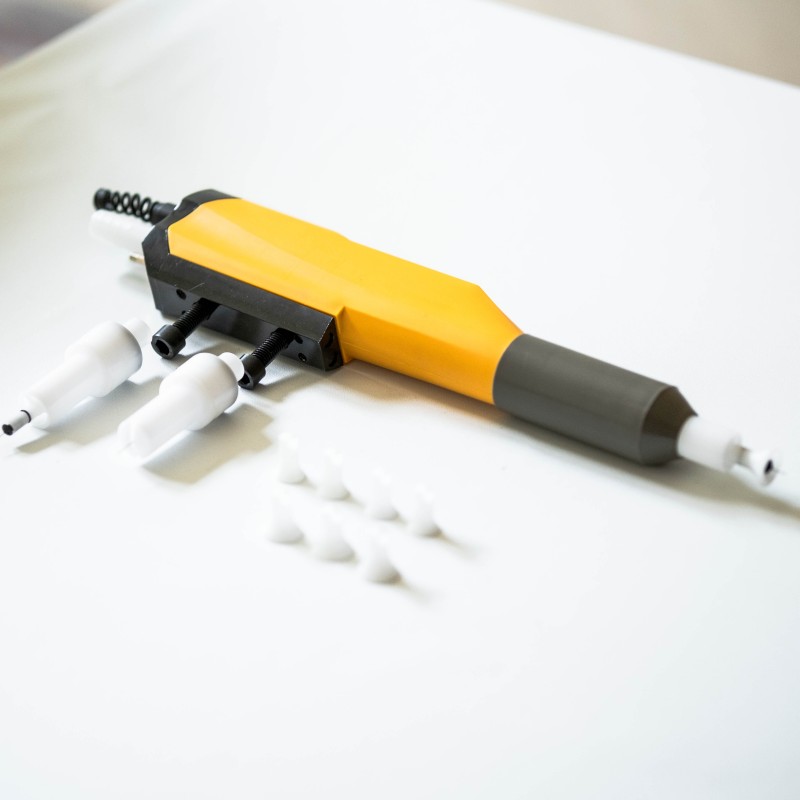
Why Robotic Automation Eliminates Variability in Powder Coating Spray Gun Performance
Human factors vs. robotic precision: Distance, angle, and powder flow rate control
Manual powder coating introduces inherent variability due to physiological and environmental constraints. Fatigue, inconsistent training, and real-time booth conditions cause operators to deviate from optimal spray parameters—commonly ±2 inches in standoff distance and ±15° in gun angle—while powder flow fluctuates beyond ±10% under variable air pressure or humidity. These inconsistencies directly produce defects like orange peel, dry spray, and coverage gaps. In contrast, robotic systems lock critical application variables: a fixed 6–8 inch standoff, a 90° perpendicular spray angle (±1° tolerance), and powder flow regulated within ±2% variance. This repeatability eliminates operator-dependent drift and reduces material waste by 25–30% compared to manual methods, per industry benchmarks from the Powder Coating Institute.
Real-time closed-loop feedback: Sensors correcting spray gun parameters mid-cycle
Even precisely programmed robots must adapt to part geometry variances, thermal expansion, or airflow shifts during operation. Robotic powder coating systems address this with integrated sensor networks that enable continuous, sub-second corrections:
| Parameter | Sensor Type | Correction Mechanism | Tolerance Improvement |
|---|---|---|---|
| Film Thickness | Non-contact eddy current | Modulates flow rate and gun speed | ±0.2 mil consistency |
| Spray Distance | Ultrasonic/LIDAR | Adjusts Z-axis position | ±0.5 mm precision |
| Gun Orientation | 3D vision systems | Recalculates angular trajectory | ±0.8° accuracy |
| Powder Dispersion | Electrostatic monitors | Regulates kV charge and fluidization | ±3% deposition variance |
These systems execute 20–30 micro-adjustments per second—detecting thin film on complex edges and instantly increasing flow while optimizing path velocity. Unlike open-loop automation, this responsiveness prevents defects before they manifest, reducing scrap rates by up to 90%, according to 2023 data from the American Electroplaters and Surface Finishers Society (AESF).
Key Components of a Robotic Powder Coating Spray Gun System
6-axis robotic arms, reciprocators, and smart nozzles — integration logic and functional synergy
Precision in robotic powder coating arises from the coordinated function of three core components. Six-axis robotic arms deliver ±0.1 mm positional repeatability, enabling exact gun placement around intricate parts—critical for aerospace and automotive applications where micron-level uniformity affects corrosion resistance and adhesion. Reciprocators extend vertical and horizontal reach, ensuring consistent coverage across tall or wide substrates without repositioning. Smart nozzles embed real-time sensors to dynamically regulate powder flow, electrostatic charge, and atomization based on ambient humidity and part conductivity.
All three components share data through a centralized controller, creating a true closed-loop system: the arm follows its programmed trajectory, the reciprocator modulates stroke length and frequency, and the nozzle self-corrects using thickness feedback. This synergy cuts overspray by 30% versus manual processes, as confirmed in controlled trials published by the Federation of Manufacturing Technology (FMA). The result is not just consistency—but predictable, specification-compliant finishes across high-mix, low-volume production runs.
Measurable Gains in Consistency and Cost Efficiency from Powder Coating Spray Gun Automation
Case evidence: Thickness variance reduced by 92% (±2.3 µm → ±0.4 µm) using robotic spray guns
Robotic spray gun systems achieve statistically significant gains in coating consistency. Independent testing across Tier 1 automotive suppliers shows thickness variation shrinking from ±2.3 µm in manual applications to ±0.4 µm under robotic control—a 92% reduction. This improvement stems from deterministic path execution, real-time parameter modulation, and elimination of human reaction lag. Crucially, this level of control correlates directly with first-pass yield increases exceeding 15%, particularly on geometrically complex parts requiring tight tolerances.
| Performance Metric | Manual Application | Robotic System | Improvement |
|---|---|---|---|
| Coating Thickness Variance | ±2.3 µm | ±0.4 µm | 92% reduction |
| First-Pass Yield | 78% | 93% | 15% increase |
| Material Overspray | 35–40% | 12–15% | 65% reduction |
CAPEX vs. TCO: How scrap reduction and yield improvement lower cost per coated part
While initial investment in robotic powder coating systems is substantial, Total Cost of Ownership (TCO) analysis reveals rapid payback. A typical implementation yields a 40% reduction in scrap and 20% higher throughput—driving a 31% decrease in cost per coated part within 18 months. Retrofitting existing lines amplifies ROI: leveraging legacy conveyor infrastructure avoids full-line replacement costs and maintains production continuity. According to the National Association of Manufacturers (NAM), facilities adopting modular robotic upgrades report breakeven at 14.2 months on average—making automation financially viable even for mid-sized job shops.
Scalable Integration of Robotic Powder Coating Spray Guns into Legacy Production Lines
Modular retrofitting: Preserving conveyor infrastructure while upgrading spray gun precision
Robotic powder coating integration need not mean greenfield investment. Modular retrofitting allows manufacturers to retain functional conveyor systems while upgrading only the application station—mounting robotic arms directly onto existing frames and synchronizing motion via programmable logic controllers (PLCs). This approach cuts installation costs by 60–75% versus full-line replacement and avoids extended production downtime.
Smart nozzles replace manual guns without altering booth layout, maintaining optimal distance and angle across varying part profiles. Integrated thickness sensors feed real-time data back to the controller, enabling dynamic flow and voltage adjustments mid-cycle. Facilities deploy incrementally—one station at a time—scaling automation in line with demand growth. Early adopters report 30–50% reductions in material waste and near-total elimination of rework within 12–18 months, transforming aging lines into agile, specification-grade coating assets—without discarding proven infrastructure.
FAQ
Why is robotic powder coating more consistent than manual methods?
Robotic powder coating eliminates variability by locking application parameters, such as spray distance and angle, and using real-time sensors to correct any deviations.
What are the key benefits of integrating robots into powder coating processes?
Key benefits include reduced material waste, higher first-pass yield, and significant improvements in consistency and cost efficiency.
Can existing production lines be upgraded with robotic systems?
Yes, modular retrofitting allows manufacturers to integrate robots into existing production lines while preserving existing infrastructure.
Table of Contents
- Why Robotic Automation Eliminates Variability in Powder Coating Spray Gun Performance
- Key Components of a Robotic Powder Coating Spray Gun System
- Measurable Gains in Consistency and Cost Efficiency from Powder Coating Spray Gun Automation
- Scalable Integration of Robotic Powder Coating Spray Guns into Legacy Production Lines
- FAQ